How to rank in ChatGPT: a 6-step playbook for B2B SaaS
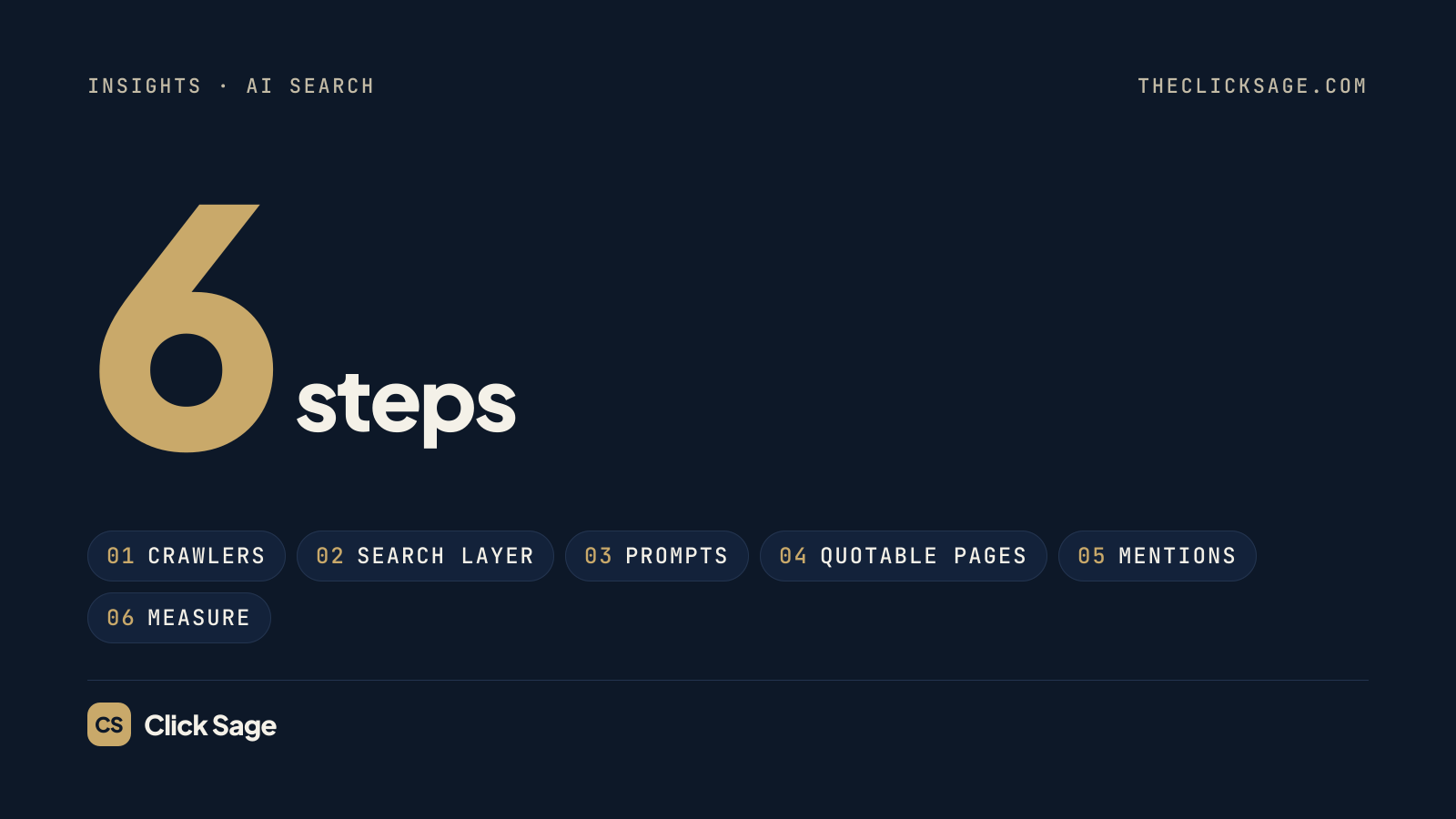
There's no ChatGPT ranking formula, and no way to submit your site. There is a clear set of things that decide whether ChatGPT can find, trust and cite your brand. Here's a six-step playbook for B2B SaaS, separating what OpenAI documents from what practitioners observe.
AI search · Oct 14, 2026 · 7 min read · By Click Sage
Your buyers are asking ChatGPT for vendor shortlists. "What's the best SOC 2 compliance software for a 50-person startup?" "Alternatives to [your competitor]?" The answer names a handful of companies. If you're not one of them, you may never hear about the deal.
"Ranking" in ChatGPT doesn't work like Google. There's no page of ten blue links and no published formula. OpenAI doesn't offer a way to submit or pay for a place in its answers. There is, though, a clear set of things that decide whether ChatGPT can find your site, trust it and cite it.
This playbook covers six steps. Where OpenAI documents how something works, we say so. Where advice comes from practitioners observing results, we say that too. A lot of what's written about this topic blurs the two.
What "ranking in ChatGPT" actually means
ChatGPT can talk about your company in two different ways:
From what the model already knows. Its training data shapes what it says about your category and brand, even with no web search. You influence this slowly, by being consistently described across the web.
From a live search. When ChatGPT searches the web, it reads pages, writes an answer and cites sources with links. This is the part you can influence fastest, and the part that sends visitors.
There are also two kinds of win: being cited (linked as a source) and being mentioned (named as a recommendation). For B2B SaaS, being named on a shortlist is often worth more than the click. We track both together as Answer Share: the share of high-intent AI answers and search results in your category that cite or rank your brand.
Step 1: Let the right OpenAI crawlers in
This is the step most often broken by accident, and the only one OpenAI fully documents. OpenAI runs separate crawlers for separate jobs:
OAI-SearchBot surfaces websites in ChatGPT's search features. OpenAI's documentation says sites that block it won't be shown in ChatGPT search answers, apart from bare navigational links.
GPTBot collects content that may be used to train OpenAI's models. Blocking it is a training decision only. It's independent of search.
ChatGPT-User visits a page when a user asks ChatGPT about it directly. OpenAI notes that because these visits are user-initiated, robots.txt rules may not apply, and this agent doesn't decide what appears in search.
How to check: read your robots.txt and look for rules covering OAI-SearchBot, GPTBot or a blanket User-agent: * disallow. Then check your CDN or firewall settings, because some bot-protection tools block AI crawlers by default, regardless of robots.txt.
Fix: allow OAI-SearchBot, make a deliberate business decision about GPTBot, and make sure your firewall doesn't block OpenAI's published crawler IP ranges. OpenAI says robots.txt changes take about 24 hours to affect search.
Step 2: Make sure the search layer can find you
ChatGPT can only cite pages it can find and read. OpenAI documents its own search crawler and indexed web content. It doesn't publish full details of any other search sources an answer may draw on.
Practically, that means three things:
Be indexed in Google and Bing. Verify your site in Google Search Console and Bing Webmaster Tools, and submit your sitemap to both. It costs nothing and covers you whichever sources an answer draws on.
Serve your content as HTML. If your marketing pages only render their text with JavaScript, some crawlers will see an empty page. Our guide to technical SEO for SaaS covers how to check.
Keep pages fast and stable. Pages that time out or block crawlers don't get read.
Done when: your key pages are indexed in both Google and Bing, and their main text appears in the page source.
Step 3: Find the prompts that decide your deals
You can't optimize for every possible question, so start with the ones closest to revenue. Write 20 to 50 realistic prompts your buyers would ask at the shortlist stage:
"Best [category] software for [company size or industry]"
"[Competitor] alternatives for [use case]"
"[Your brand] vs [competitor]"
"Does [your brand] integrate with [tool they use]?"
"How much does [category] software cost?"
Use the words your buyers actually use. Sales calls and lost-deal notes are the best source; our guide to SaaS keyword research explains how to collect them.
Then run each prompt in ChatGPT with search enabled, and record who gets named, who gets cited and which pages are linked. Run them more than once: answers vary from run to run, so a single result isn't a reliable baseline.
Practitioners widely observe that ChatGPT often breaks one prompt into several smaller searches before answering. It's a good reason to cover the related sub-questions, such as pricing, integrations, security and implementation time, not just the headline question.
Done when: you have a prompt list and a baseline of who wins each one today.
Step 4: Write pages ChatGPT can quote
When ChatGPT reads a page to answer a question, it needs to find a clear, correct, self-contained answer quickly. Pages that bury the answer in marketing copy are harder to use.
Answer first. Under each heading, open with a direct one- or two-sentence answer, then add detail.
Use the question as the heading. "How much does X cost?" and "X vs Y: which is better for startups?" match how buyers prompt.
Be specific. Name who the product is for, which integrations it has, what it costs or how pricing works, and where it's not the right fit. Vague claims like "the leading platform" give an AI system nothing to repeat.
Use tables for comparisons. Feature-by-feature tables are easy to read for people and machines alike.
Show dates and authorship. Make it obvious when a page was updated and who stands behind it.
Publish what can't be found elsewhere. Original data, benchmarks, clear definitions and honest comparisons give ChatGPT a reason to cite you rather than a summary of you.
Done when: your comparison, alternatives, pricing and integration pages each answer their core question in the first lines.
Step 5: Be the brand other sources mention
For shortlist questions, AI answers lean heavily on what others say about you: review sites, "best of" roundups, community discussions, partner directories and industry publications. Practitioners consistently see that brands mentioned across many independent sources are named more often than brands that only describe themselves.
Review sites: keep your G2 and Capterra profiles complete and current, and encourage genuine reviews from real customers.
Roundups: find the "best [category] software" articles that ChatGPT cites for your prompts, and pitch the publishers on including you, with real information, not payment-for-placement schemes.
Communities: have your team answer questions genuinely where your buyers talk, such as Reddit, Slack communities and LinkedIn, without spamming links.
Partners: get listed in the integration marketplaces and partner directories of the tools you connect with.
Consistency: make sure your positioning, pricing model and core facts read the same everywhere. Conflicting information makes you a riskier source to quote.
Done when: you know which third-party pages ChatGPT cites for your prompts, and you have a plan to earn a credible mention on the top five.
Step 6: Measure, because answers are volatile
AI answers change often, so measure trends rather than single results.
Re-run your prompt set monthly, several times each, and track your Answer Share over time.
Track ChatGPT referrals. In GA4, look for sessions from
chatgpt.com. Links from ChatGPT often carryutm_source=chatgpt.com, which makes them easy to separate from other referrals.Ask buyers. Add "How did you hear about us?" to your demo form. Many people who meet you in ChatGPT later arrive through a branded Google search, and analytics alone will miss them.
Connect it to pipeline. Count demos and opportunities that came from AI assistants, not just visits. Our SaaS SEO checklist shows how to set that up in your CRM.
Done when: you have a monthly view of Answer Share, ChatGPT referrals and AI-sourced pipeline.
What doesn't work
Trying to "submit" your site to ChatGPT. There's no submission process for its answers. Being crawlable and indexed is how you get in.
Assuming ads buy recommendations. ChatGPT has an ads program, but paid placements are separate from the answers it writes.
Relying on llms.txt. It's a proposed convention, and OpenAI hasn't documented using it to choose sources. It's harmless, but don't make it your strategy.
Keyword stuffing and AI-generated filler. Pages written to game a system rather than answer a buyer give AI assistants nothing worth citing.
Fake reviews and self-written "best of" lists. Besides the trust risk, fake reviews are now a regulatory risk in the US and Canada.
Frequently asked questions
How long does it take to show up in ChatGPT?
Technical fixes, like unblocking OAI-SearchBot, can take effect within days; OpenAI says robots.txt changes apply in about 24 hours. Earning mentions and citations for competitive shortlist questions usually takes months, because it depends on third-party coverage and on your pages becoming the best answer.
Does ranking on Google help you rank in ChatGPT?
It helps, but it isn't the same thing. Strong, indexable pages that rank well in search are more likely to be found and read when ChatGPT searches. ChatGPT also weighs what other sources say about you and how clearly your pages answer the specific prompt.
Can you pay to rank in ChatGPT?
Not in its answers. ChatGPT's ads are a separate, paid placement. Being named or cited in the answer itself comes from being findable, quotable and mentioned by credible sources.
Is optimizing for ChatGPT different from optimizing for Perplexity or Google AI Overviews?
The foundations are the same: crawlable pages, clear answers and third-party credibility. The differences are mostly in crawlers and sources. Each assistant has its own crawler to allow, and each leans on its own mix of search indexes and sources. Track your prompts in each assistant your buyers use.
Want to know where your brand stands in ChatGPT today? Our AI SEO service starts with an AI visibility audit and Answer Share baseline for your category's buying prompts. Book a strategy call to see yours.
Want this applied to your pipeline?
A 30-minute strategy call: we look at where you show up in AI answers and search today, and what would move it.
Related
SaaS PPC: how to run paid ads that create pipeline, not just leads
Paid media · Oct 17, 2026 · 6 min read
Most SaaS PPC accounts are optimized for cheap leads and judged on cost per lead, so they buy plenty of form fills and little pipeline. Here's how to run paid search and paid social for B2B SaaS that's measured, and bid, on the opportunities it creates.
A SaaS content strategy built on buyer questions
Content · Oct 17, 2026 · 6 min read
Most SaaS content calendars are lists of topics someone thought were interesting. This strategy starts from the questions your buyers actually ask, gives each one a single page, puts that page to work across search, AI answers, email, social and sales, and measures it in pipeline.
Brand mentions in ChatGPT: how to track them, and what they're worth
Measurement · Oct 14, 2026 · 7 min read
ChatGPT has no Search Console. To know whether it recommends your brand, you have to measure it yourself, and one answer tells you almost nothing. Here's a 5-step, tool-neutral method for B2B SaaS: clean, repeated runs, Answer Share scoring, accuracy audits and pipeline attribution.