SaaS PPC: how to run paid ads that create pipeline, not just leads
Most SaaS PPC accounts are optimized for cheap leads and judged on cost per lead, so they buy plenty of form fills and little pipeline. Here's how to run paid search and paid social for B2B SaaS that's measured, and bid, on the opportunities it creates.
Paid media · Oct 17, 2026 · 6 min read · By Click Sage
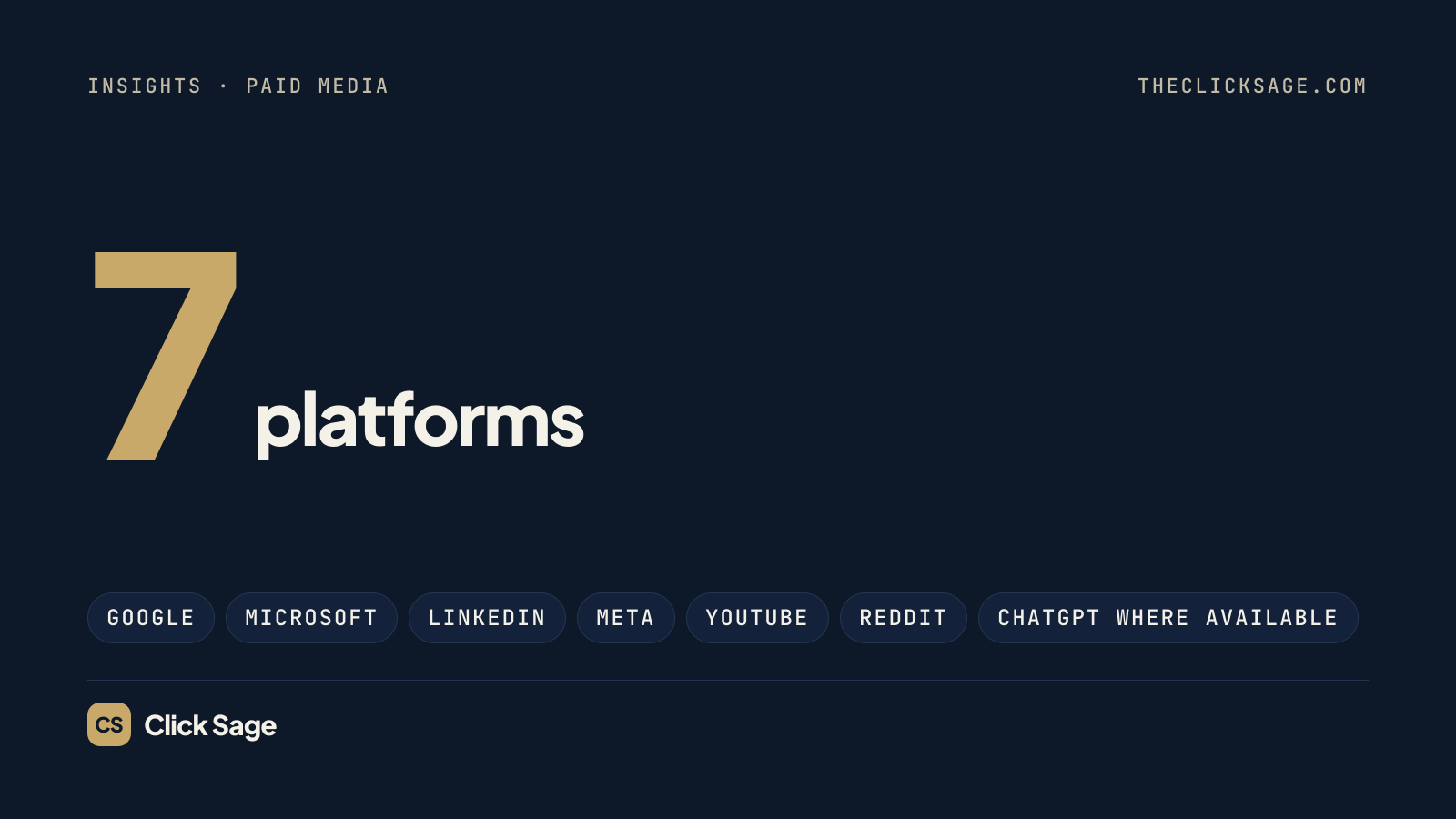
Most SaaS PPC accounts look healthy in the ad platform and disappointing in the CRM. Cost per lead is down, form fills are up, and sales says the leads are poor.
That's not bad luck. Ad platforms optimize for whatever you tell them counts as a conversion. If that's a form fill, they'll find you the cheapest form fills available, including students, competitors and people who'll never buy. B2B SaaS deals involve long sales cycles and several decision-makers, and they rarely close from a single click.
This guide covers how to run paid ads for B2B SaaS that are judged, and bid, on pipeline. It's how our SaaS PPC agency work runs.
Step 1: Work out what an opportunity is worth
Before you set a budget or a target, work backwards from revenue. You need three numbers from your CRM:
Average contract value, ideally first-year, by segment.
Win rate from qualified opportunity to closed-won.
Sales cycle length, so you know how long results take to show up.
From those, you can set a target cost per qualified opportunity you can afford, and a payback period you're comfortable with. An illustrative example, with made-up numbers: if a deal is worth $24,000 in its first year and you win one in four qualified opportunities, each opportunity is worth about $6,000 in expected first-year revenue. That tells you how much you can afford to pay for one.
Done when: you have a target cost per qualified opportunity, by segment, that finance agrees with.
Step 2: Track the outcomes you actually want
This is the step most accounts skip, and the one that matters most. Connect your ad platforms to your CRM so they learn from qualified opportunities and deals, not just form fills.
Capture click IDs. Store Google's click ID (GCLID), plus the equivalent IDs and UTM parameters for other platforms, with every lead in your CRM.
Send CRM stages back. Google Ads offline conversion import lets you upload later outcomes, such as a qualified opportunity or a closed deal, against the original click. Google accepts these conversions for clicks within its import window, up to 90 days. LinkedIn and Meta offer their own conversions APIs for the same purpose.
Value each stage. Give stages a value that reflects how likely they are to become revenue, so the platform can tell a strong lead from a weak one.
Bid on the earliest stage with enough volume. Automated bidding needs a steady flow of conversions to learn from. If closed-won deals are too rare, optimize toward qualified opportunities instead.
Done when: your ad platforms receive qualified-opportunity conversions from your CRM, and bidding targets them.
Step 3: Start with the searches closest to revenue
Search captures demand that already exists. Spend it on buyers who are evaluating, before people who are just curious:
Competitor and alternatives searches: "[competitor] alternatives", "[competitor] vs [category]". Some of the highest-intent clicks in SaaS.
Category plus a qualifier: "[category] software for [industry or size]".
Integration searches: "[category] that integrates with Salesforce".
Your own brand: protect it, but report it separately; brand clicks aren't new demand.
Build a strong negative keyword list from day one: jobs, careers, free, login, tutorial, template and anything else that signals someone who isn't buying. Review the search terms report weekly.
Don't skip Microsoft Advertising (Bing). It reaches a different slice of work computers. In supported markets it also lets you target by LinkedIn profile data, such as company, industry and job function.
Done when: most search spend sits on evaluating-stage keywords, with brand reported separately and a maintained negative list.
Step 4: Use paid social to reach the right accounts
Paid social creates demand rather than capturing it, so judge it over a longer window. Pick platforms by where your buyers are:
LinkedIn: the most precise B2B targeting. Upload the account lists your data team builds, target the buying committee by role, and use Thought Leader ads to promote posts from your founders and experts. Lead gen forms are convenient, but track their quality in the CRM before you scale them.
Meta (Facebook and Instagram): strong for retargeting site visitors and reaching uploaded customer and prospect lists, and for some SaaS segments, like founders of smaller companies, it can work for prospecting too.
Reddit: reach buyers in the communities where they compare tools and ask for recommendations. Ads there work best when they're useful and honest, not salesy.
YouTube: product demos, explainers and customer-style walkthroughs, plus retargeting people who've visited your pricing or comparison pages.
Done when: each social platform has a clear audience, a defined role (prospecting or retargeting), and a pipeline target measured over your sales cycle.
Step 5: Send clicks to pages that match the question
The fastest way to waste a good click is to send it to your homepage. Match the landing page to what the person searched or saw:
Competitor searches go to an honest comparison page.
Category and use-case searches go to a page about that use case.
Integration searches go to the integration page.
Retargeting can go straight to a demo or pricing page.
Keep forms short, explain your pricing model, and show who the product is for. Your evaluating-stage content pages often make better landing pages than anything built just for ads.
Done when: every campaign has a landing page that answers the question behind the click.
Step 6: Budget and test with discipline
Concentrate budget. A few well-funded campaigns learn faster than many starved ones.
Test one thing at a time: an audience, an offer or a message, not all three at once.
Give campaigns time to learn before judging them, and judge them on cost per qualified opportunity, not cost per lead.
Cut on pipeline, not clicks. A campaign with expensive leads that turn into opportunities beats one with cheap leads that don't.
Done when: every budget change is justified by pipeline data, not platform metrics alone.
Step 7: Don't forget AI answers
Buyers increasingly ask AI assistants for shortlists before they ever search. Where it's available to you, ChatGPT Ads can put your brand in front of buyers inside those conversations. It works best alongside earning organic citations, which is what our AI search work does, so you can earn the citation and buy the placement.
What to report every month
Cost per qualified opportunity and pipeline per ad dollar, by platform and campaign.
Opportunities and closed-won revenue from paid, including deals influenced by paid touches.
Brand vs non-brand search, reported separately.
Payback period against the target you set in Step 1.
Our SaaS SEO checklist shows how to define sourced and influenced pipeline with your sales team, so paid and organic are measured the same way.
Common mistakes
Optimizing for cost per lead. The platform will find you cheap leads that don't buy.
Bidding on brand and calling it growth. Brand clicks are mostly people who already know you.
Broad keywords with no negatives. Budgets drain into jobs, tutorials and free-tool searches.
One landing page for everything. Relevance drops, and so does conversion.
Judging paid social by the same window as search. Demand creation takes longer to show up in pipeline.
Frequently asked questions
Should a SaaS company start with Google Ads or LinkedIn Ads?
Usually with search, because it captures buyers who are already looking. Add LinkedIn once tracking is in place and you know which accounts you want to reach. If search volume in your category is very low, LinkedIn may need to lead.
How much should a SaaS company spend on PPC?
Work backwards from what an opportunity is worth to you (Step 1), and fund enough campaigns for the platforms to learn. Spreading a small budget across every platform at once usually produces noise rather than pipeline.
How long does SaaS PPC take to work?
Search can show early signals within weeks. Proving pipeline takes at least one sales cycle, and paid social usually takes longer than search to show up in closed revenue.
Is a SaaS PPC agency worth it?
It can be, if the agency measures itself on pipeline rather than clicks or leads, connects your ad accounts to your CRM, and runs everything in your own accounts. Ask how they'll report cost per qualified opportunity before you hire.
Want your paid ads judged on pipeline instead of leads? Book a strategy call. We'll look at what an opportunity is worth to you, and where your ad spend is going today.
Want this applied to your pipeline?
A 30-minute strategy call: we look at where you show up in AI answers and search today, and what would move it.
Related
A SaaS content strategy built on buyer questions
Content · Oct 17, 2026 · 6 min read
Most SaaS content calendars are lists of topics someone thought were interesting. This strategy starts from the questions your buyers actually ask, gives each one a single page, puts that page to work across search, AI answers, email, social and sales, and measures it in pipeline.
Brand mentions in ChatGPT: how to track them, and what they're worth
Measurement · Oct 14, 2026 · 7 min read
ChatGPT has no Search Console. To know whether it recommends your brand, you have to measure it yourself, and one answer tells you almost nothing. Here's a 5-step, tool-neutral method for B2B SaaS: clean, repeated runs, Answer Share scoring, accuracy audits and pipeline attribution.
How to rank in ChatGPT: a 6-step playbook for B2B SaaS
AI search · Oct 14, 2026 · 7 min read
There's no ChatGPT ranking formula, and no way to submit your site. There is a clear set of things that decide whether ChatGPT can find, trust and cite your brand. Here's a six-step playbook for B2B SaaS, separating what OpenAI documents from what practitioners observe.